
The air cooler occupies a particular niche in the domestic cooling market. Neither a fan nor a portable air conditioner, this device works by evaporating water to lower the ambient temperature by a few degrees. Its positioning as an energy-efficient supplementary solution is appealing, but its real limitations deserve careful consideration before any purchase.
Evaporative cooling: what physics allows and what it prohibits
The principle is simple: warm air passes through a wet pad, water evaporates, and absorbs heat. The temperature of the blown air decreases. This mechanism works better when the ambient air is dry. In a region where the relative humidity already exceeds a certain threshold, the thermal gain becomes marginal.
Related reading : How to Choose the Best Pruner for Safely Maintaining Your Trees
This is the central constraint that many commercial guides downplay. An effective air cooler in the south of France during mistral winds may prove nearly ineffective during a humid episode in Brittany or in the Rhône Valley after a storm. Field reports vary on this point, precisely because hygrometric conditions vary greatly from room to room and from day to day.
Product sheets generally announce a temperature drop of a few degrees. This figure corresponds to optimal testing conditions, rarely replicated in a furnished living room with occupants. A reliable comparison, such as those offered on rafraichisseurdair.com, helps to confront marketing promises with measured performance in real situations.
Related reading : How to choose the best home products awarded this year?
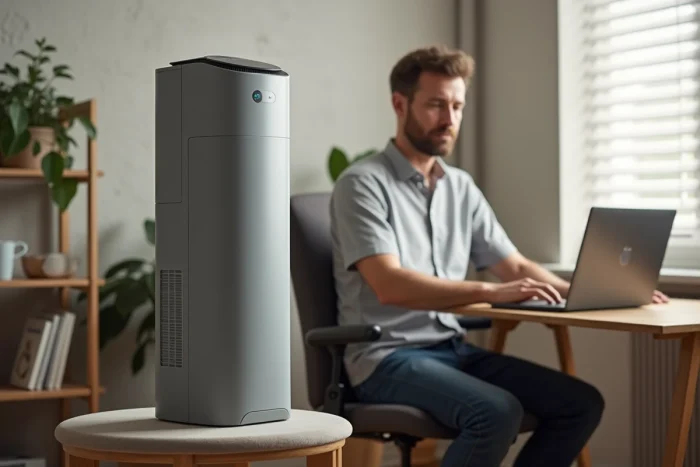
Air cooler in the bedroom at night: humidity and noise under the microscope
Using a cooler while sleeping presents two concrete problems that comparisons rarely address in depth.
The trap of nighttime humidity
A closed bedroom at night already accumulates moisture produced by the occupants’ breathing. Adding a device that injects water vapor into the air can raise the humidity level beyond the comfort threshold. Instead of cooling, the device can make the atmosphere damp and oppressive.
The solution is to leave a window slightly open or the bedroom door open to renew the air. However, this ventilation reduces the cooling efficiency since the fresh air produced partially escapes. This is a real trade-off, not a detail.
Noise level, an underestimated criterion
A cooler fan runs continuously. Even at low speed, the noise generated can disturb light sleepers. The available data does not allow for a conclusion that one type of cooler is systematically quieter than another: the noise level depends on the motor, the design of the airflow, and the quality of manufacturing.
Checking the noise level in decibels on the technical sheet remains the only reliable way to anticipate this parameter. Models with a night mode reduce the ventilation speed, but the compromise between coolness and silence remains tight.
Tank capacity and room size: the sizing that changes everything
The volume of the water tank determines the device’s autonomy. A tank that is too small requires refilling several times a day, which quickly becomes cumbersome. Conversely, an oversized tank on a model intended for a small room unnecessarily weighs down and clutters the device.
The size of the room dictates the necessary airflow. A cooler designed for a small space will have no noticeable effect in a large open living area. The most rigorous guides recommend cross-referencing these two parameters:
- The volume of the tank, which determines the duration of operation without intervention
- The airflow in cubic meters per hour, to be related to the volume of the targeted room
- The presence or absence of ice packs, which temporarily improve cooling but melt in a few hours
- The ability to adjust the direction of the airflow, useful for targeting a specific area rather than diluting the coolness throughout the space
An undersized cooler does not cool, it ventilates. This distinction makes all the difference between a satisfying purchase and a disappointment.
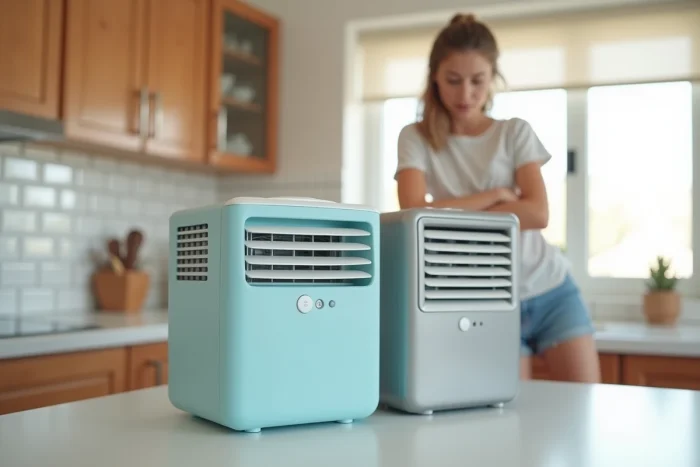
Air cooler, fan, or portable air conditioner: where to place the cursor
The air cooler sits between a traditional fan and a portable air conditioner, both in price and performance. The fan circulates air without changing its temperature. The portable air conditioner produces real cold using a compressor, but consumes significantly more energy and requires expelling hot air through a window.
The air cooler is a supplementary solution, not an air conditioning system. Recent content emphasizes this distinction, placing it in a logic of complementing other actions: cross-ventilation in the morning and evening, closing shutters during hot hours, managing indoor humidity.
For an entire house during a heatwave, an air cooler alone will not suffice. For a specific room for a few hours, in a dry climate, it can offer a real comfort gain at lower energy cost.
What sponsored rankings don’t always say
Online comparisons often contain affiliate links. The highlighted model is not necessarily the most efficient: it is sometimes the one that generates the best commission. Distinguishing an independent editorial test from a commercial selection requires checking whether the article details a testing methodology or merely repeats the manufacturer’s arguments.
- A reliable comparison mentions the measurement conditions (ambient temperature, humidity, room size)
- A commercial ranking often merely lists technical characteristics without contextualizing them
- User reviews on commercial sites provide useful field feedback, provided that overly short or obviously solicited reviews are filtered out
The choice of an air cooler relies on three concrete parameters: the local climate, the size of the targeted room, and the intended use (day or night). No model is suitable for all situations. Establishing these criteria before consulting a comparison avoids being guided by a ranking whose logic is primarily commercial.