
A cake that rises like a hot air balloon in the oven and then collapses on the cooling rack is almost always due to an excess of baking powder. We use an entire packet “to be sure,” and the result is a crumbly texture, a metallic aftertaste, and a texture that deflates within minutes.
Why an excess of baking powder causes the cake to fall
Baking powder produces carbon dioxide bubbles when its acidic and basic components react in the presence of liquid and heat. With the right amount, these bubbles remain trapped in the network formed by the proteins in the eggs and the gluten in the flour. The batter rises evenly and retains its structure once cooled.
You may also like : How much does it cost to fill in a pool and how to successfully renovate it?
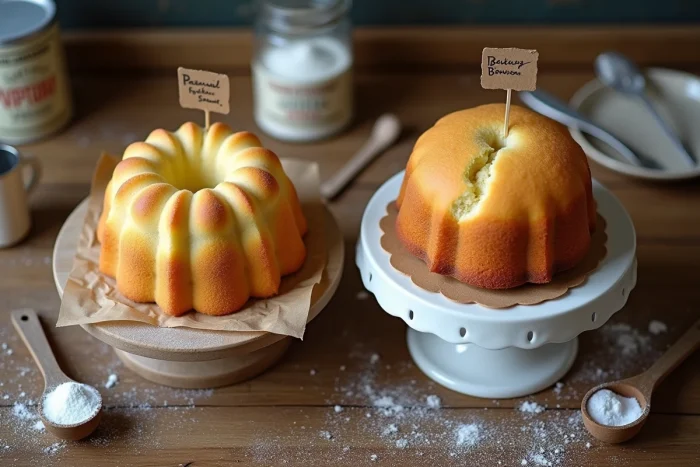
With an excess, the batter rises too quickly and collapses as it cools. The carbon dioxide is produced in quantities that the structure of the batter cannot hold. The walls of the bubbles give way, and the cake falls in on itself as soon as it comes out of the oven. You end up with a dense dessert in the center, sometimes hollow, with a domed crust that cracks.
The taste is also affected: an excess of sodium bicarbonate not neutralized by acid leaves an unpleasant bitterness. This flaw is sometimes confused with a cooking or flour problem, while the baking powder is the sole culprit.
Read also : Ideas and Inspirations to Transform Your Interior with Style and Creativity
To better understand the mechanisms at play and avoid too much baking powder in a cake, it is beneficial to examine the acid-base reaction rather than simply following the amounts indicated on the packet.
Baking powder dosage per recipe: concrete guidelines
Most packets of baking powder in supermarkets contain a dosage designed for a standard amount of flour. The reflex to use an entire packet regardless of the volume of batter is the primary source of excess.
Adjust the amount to the flour
We think in terms of flour/baking powder ratio. Reducing the baking powder when the recipe contains little flour avoids most failures. A yogurt cake with a small pot of flour does not need the same amount as a dense travel cake.
Feedback varies on this point depending on the type of recipe, but a reliable approach is to use a level teaspoon of baking powder for a moderate amount of flour, then adjust upwards only if the recipe justifies it (heavy batter, presence of fruits, addition of cocoa).
Weigh rather than estimate
A “heaping” teaspoon can contain double that of a level teaspoon. We underestimate this factor. Using a precision scale radically changes the consistency of results. Professional bakers systematically weigh their leavening agents to the nearest gram, and we should do the same at home.
Correcting a batter with too much baking powder before baking
You’ve poured in too much baking powder and realize it before putting it in the oven. Rather than throwing everything away, you can rebalance the cake batter.
- Increase the amount of flour slightly to give the batter a network capable of holding the excess gas. Add in small amounts while gently mixing, without overworking the batter.
- Add a little liquid (milk, yogurt, cream) to compensate for the thickening due to the extra flour and regain the original texture.
- Incorporate a mild acid (a few drops of lemon juice or a dash of white vinegar) to neutralize the excess sodium bicarbonate and limit the bitter taste.
This batter correction works best when the excess is moderate. If you’ve added double the amount, the result will remain compromised, and it’s better to start the recipe again with the correct proportions.

Natural acids and rising without excess leavening powder
The acidic ingredients present in many dessert recipes are not there solely for flavor. They actively participate in the chemical reaction that makes the batter rise. By using them correctly, we can reduce the amount of baking powder without losing volume.
Yogurt, buttermilk, sour cream, and lemon juice provide the necessary acidity to activate the sodium bicarbonate. When a recipe already contains one of these ingredients, the baking powder can be reduced because the acid-base reaction occurs naturally.
Whipped egg whites: a mechanical leavening agent
Whipped egg whites incorporate air into the batter in a purely physical manner. In a cake like genoise, it is even the only leavening agent used. Whipping the egg whites to stiff peaks and gently folding them in allows for an airy crumb without any leavening powder.
For recipes that require both whole eggs and baking powder, separating the whites and whipping them before folding them in at the end of preparation results in a lighter outcome. You can then reduce the baking powder by a good third.
Sodium bicarbonate alone: when to use it
Baking soda is not baking powder. It contains no acid, which means it only reacts if the recipe includes an acidic ingredient. For a lemon cake or a yogurt cake, a small teaspoon of baking soda combined with the acid from the lemon or yogurt replaces the packet of baking powder.
- Baking soda alone, without acid, does not make the batter rise and leaves a bitter taste.
- The reaction is immediate upon contact with the acidic liquid: bake quickly after mixing.
- We use less than regular baking powder for an equivalent effect, provided the acid is present in sufficient quantity.
The last point to keep in mind concerns the oven temperature. Baking powder, even when dosed correctly, does not compensate for an oven that is too hot, which seizes the crust before the inside has finished rising. Preheating to the right temperature and not opening the door during the first half of baking protects the structure of the cake as much as precise dosing of the leavening agent.