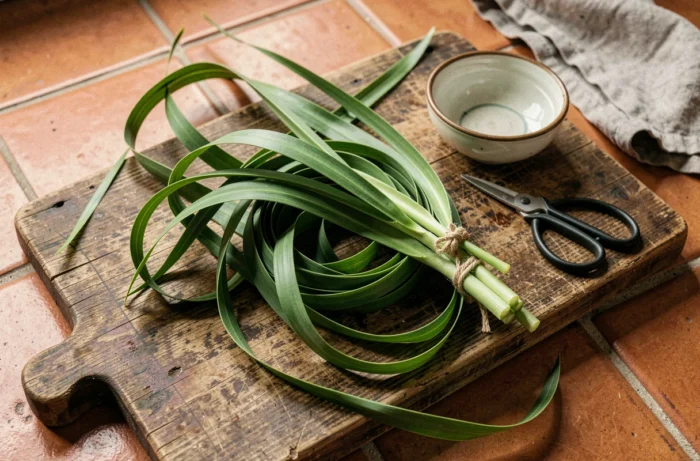
Pandan (Pandanus amaryllifolius) is a tropical plant whose long, narrow leaves are used as a flavoring across much of Southeast Asia. Their fragrance, often compared to a blend of almond and rice pudding, comes from a volatile compound called 2-acetyl-1-pyrroline (2AP).
This same compound is found in basmati rice and freshly baked bread, which explains why the aroma feels instantly familiar to European palates. Before using them in a recipe, pandan leaves need to be prepared according to their form, whether fresh, frozen or dried.
How stable is pandan’s aroma? What happens before it reaches the pan
Most cooking guides treat pandan leaves as a ready-to-use ingredient. The reality is more nuanced. 2AP, which is responsible for most of the fragrance, is described in a 2019 study as unstable: it degrades quickly after extraction, and its aromatic profile changes when exposed to air and light.
In practice, this means that pandan extract prepared the day before will not be as intense as extract made just before use. Preparing the extract at the last minute is still the best way to preserve the leaf’s full aromatic range.
Storage methods also have a direct impact. Drying, freeze-drying and freezing are not interchangeable: each method affects the 2AP content differently.
A dried leaf may be enough to flavor a liquid during a long infusion, but it will produce a much less aromatic juice than a good-quality fresh or frozen leaf. For those looking to prepare pandan leaves for cooking and achieve the right result, the choice of raw ingredient determines everything that follows.
Fresh, frozen or dried pandan leaves: which form should you choose?
In Europe, large fresh pandan leaves are rarely available. Asian grocery stores sometimes stock small leaves harvested before they are fully mature, whose aroma is still subtle.
Frozen leaves, which are larger and darker, offer a more intense aroma and a deeper green color. Several cooks specializing in Asian cuisine recommend this form without hesitation when fresh, mature leaves are unavailable.
Dried pandan leaves and pandan powder
Dried leaves keep for a long time, but lose a significant part of their fragrance. They are best used for infusing hot liquids (coconut milk, syrup or rice-cooking water), where a longer steeping time partly makes up for the loss of aroma.
Pandan powder, increasingly available on the European market, is easier to measure. Its quality varies by brand and manufacturing process. Artificial pandan extract does not faithfully reproduce the aromatic profile of the natural leaf: its intense green color and more one-dimensional flavor set it apart from the fresh product.
Extracting pandan juice: techniques and common mistakes
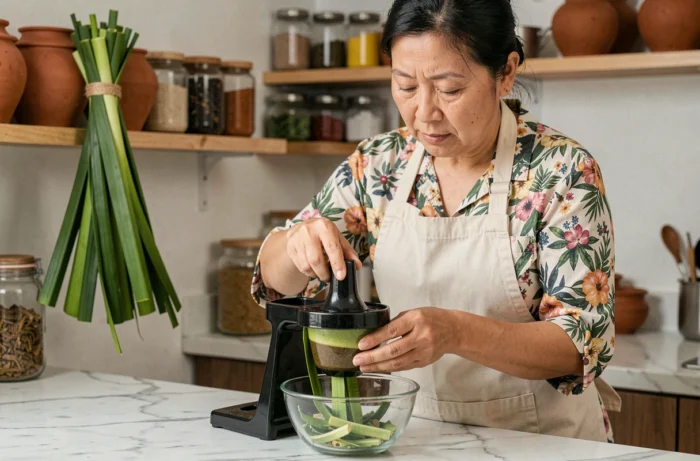
Extracting the juice is the key step in any pandan dessert recipe (kaya, pandan chiffon cake or kuih). The basic method is easy to follow with standard kitchen equipment.
- Cut the leaves into pieces a few centimeters long, then blend them with a little water in a powerful blender until you have a smooth, fibrous paste
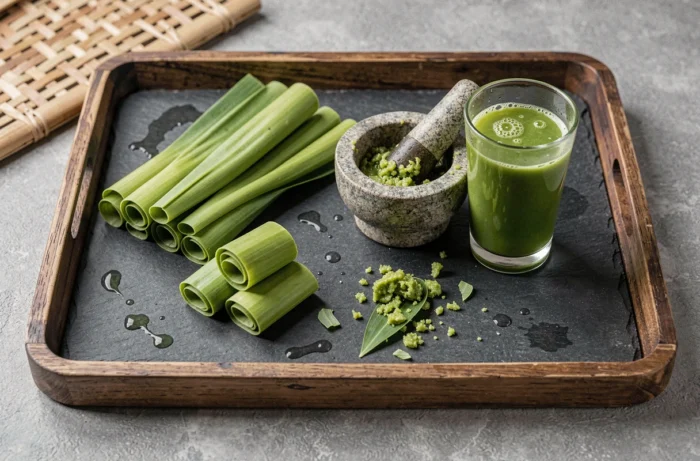
- Strain the mixture through a fine cloth or a fine-mesh sieve, pressing firmly to extract as much green juice as possible
- Let the strained juice sit for about 20 minutes: a darker, more concentrated layer will settle at the bottom of the container, where most of the pigment and aroma are concentrated
- Use this concentrate in the recipe and adjust the dilution to achieve the desired color and fragrance
The most common mistake is adding too much water when blending. The resulting juice will be diluted and pale, and its flavor will barely come through in the finished dish. Using less water produces a more intense extract and a natural green color without the need for food coloring.
A study published in December 2024 in Food Chemistry: X found that 2AP content varied depending on the leaf’s position on the plant and decreased as the leaf grew. The youngest leaves, located at the center of the rosette, are therefore likely to be the most aromatic. This is a rarely mentioned detail, but a useful one if you have access to whole fresh leaves.
Cooking pandan rice and savory infusions: how to add flavor without overpowering a dish
Beyond desserts, pandan leaves add fragrance to rice, chicken and some soups. The most common technique is to tie one or two leaves into a knot and place them directly in the rice-cooking water or broth.
The knot is not just decorative. It helps release the aromas gradually by gently crushing the fibers, while making the leaf easy to remove at the end of cooking. A leaf simply laid flat in the pan releases less flavor.
Chicken wrapped in pandan leaves
The Thai pandan chicken recipe (gai hor bai toey) uses the leaf as an aromatic wrapper. Marinated chicken pieces are wrapped in a leaf before frying. The leaf flavors the meat as it cooks and protects it from direct contact with the oil, resulting in a texture that is both tender and crisp.
For savory dishes, one or two leaves are enough to flavor an entire pot. Doubling the amount will not double the fragrance, but it may introduce an unwanted vegetal bitterness. Pandan works as a background spice, not a main ingredient.
Storage and regulations in Europe
Frozen leaves can be kept in the freezer for several months without thawing them in between. Extracted juice, on the other hand, should be used the same day to retain its aromatic intensity.
In Europe, pandan’s regulatory status deserves attention. The European Union’s Novel Food Regulation governs the marketing of foods without a significant history of consumption before 1997. Whole pandan leaves used for infusions generally pose no issues, but some concentrated extracts or processed powders may require specific authorization depending on how they are made.
Both retailers and consumers should exercise caution: checking the origin and compliance of imported products helps avoid unpleasant surprises. Pandan’s fragrance is well worth the extra care.