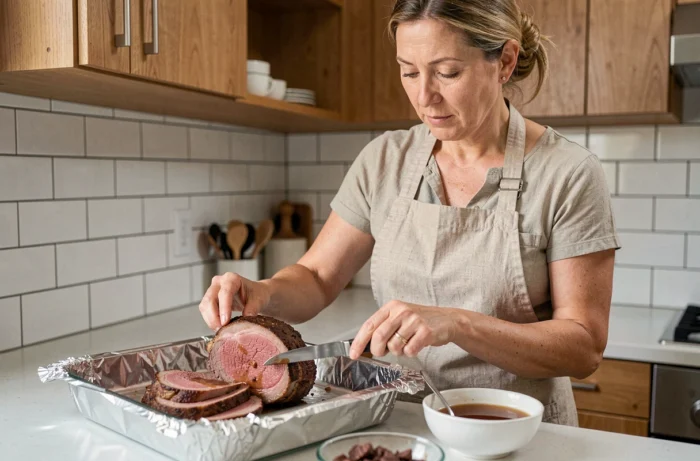
A roast beef taken out of the refrigerator presents a seemingly simple problem: bringing it back to temperature without continuing the cooking process. The difficulty lies in the fact that roasted beef quickly loses its juices as soon as its internal temperature exceeds that of the initial cooking. Reheating cooked roast beef is primarily about controlling the heat to keep it below this threshold.
Why roast beef dries out when reheated: the role of internal temperature
Have you ever noticed that reheated roast beef in a conventional oven turns gray and becomes stringy? The problem does not come from the oven itself, but from the temperature the meat reaches internally.
The muscle fibers of beef gradually contract under the effect of heat. The higher the temperature rises, the more they expel their moisture. A roast beef that was initially pink was cooked at a moderate internal temperature. If reheating pushes this temperature well beyond, the meat moves to a higher cooking stage and loses its tenderness.
The thermal probe is more reliable than a timer. The thickness of the slice, its starting temperature, and the amount being reheated greatly affect the result. A fixed reheating time guarantees nothing. The probe allows you to stop as soon as the meat is hot without exceeding the initial cooking level.
This is why it is safer to reheat cooked roast beef without recooking it by monitoring the internal temperature rather than setting a timer.
Slicing before reheating: the technique that few recipes mention
Most guides recommend reheating the whole piece, wrapped in aluminum foil. This method works, but it has a flaw: the outside of the piece heats much faster than the center. The time needed to bring the core to the right temperature is enough to recook the outer part.
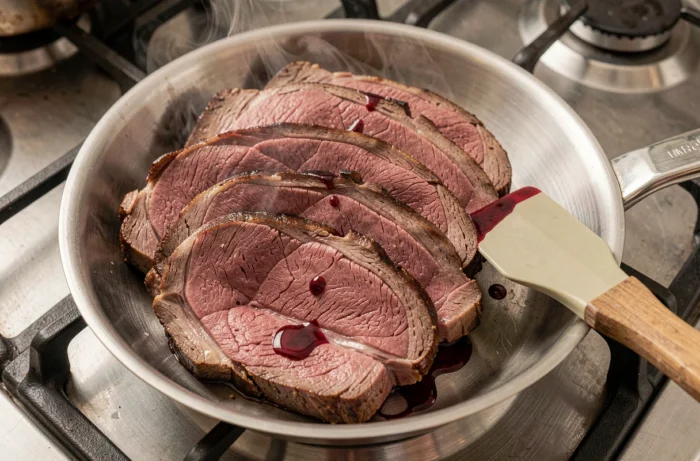
Slicing the meat before reheating reduces the time of exposure to heat. Slices a few millimeters thick reach the desired temperature much faster than a compact block. Each slice heats evenly, without a marked gradient between the edge and the center.
This approach offers another practical advantage: it allows you to only reheat the amount consumed. The rest of the roast beef stays in the refrigerator, intact, ready for another meal.
How to proceed concretely
Take the slices out of the refrigerator about twenty minutes before reheating. Meat that is less cold at the start requires less heat to reach the right temperature, which reduces the risk of overcooking.
Place the slices flat, without overlapping, in a dish suitable for the oven or pan. The surface exposed to heat should be maximized for quick and even reheating.
Reheating roast beef in the oven, in a pan, or in a water bath: three approaches compared
The choice of method depends on the desired result and the available equipment. Each has its strengths and limitations.
Low oven with moisture
Set the oven to a low temperature. Place the slices in a dish, add a bit of broth or meat juice, then cover with aluminum foil or a lid. The liquid creates steam that prevents the surface from drying out.
The low oven is well-suited for large quantities. It requires a bit of patience, but the result is consistent if the temperature remains moderate.
Pan with fat and lid
Heat a drizzle of butter or oil over low heat in a pan. Place the slices, add a spoonful of broth, then put on a lid. The lid traps steam and speeds up reheating without prolonged direct contact.
The pan is the fastest method for one or two portions. It also allows for a slight browning of the surface if you enjoy a bit of crispy texture.
Water bath or vacuum bag
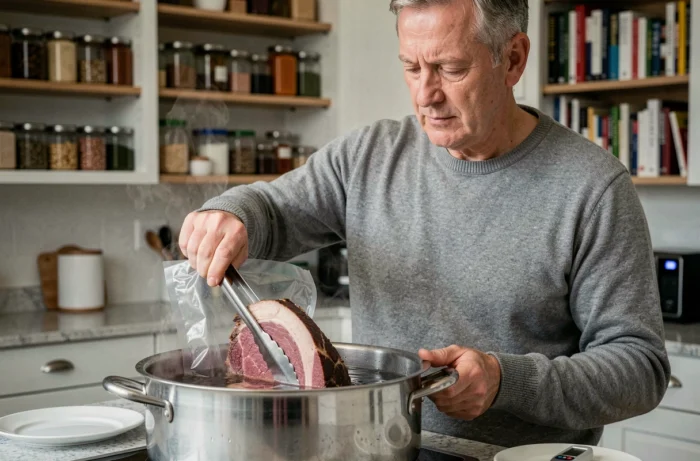
Place the slices in an airtight bag, remove the air, then submerge the bag in hot water (not boiling). The meat heats up without ever coming into direct contact with an intense heat source.
The water bath offers the most precise control and almost completely limits drying out. However, the meat does not develop any crust or coloration.
- For roast beef that should remain pink and juicy without any risk of overcooking, the water bath is the safest method.
- For a quick individual portion with a slight crispiness, the pan over low heat with a lid does the job.
- For several guests and a uniform result, the low-temperature oven with a bit of liquid remains the best compromise.
Storage and food safety before reheating roast beef
Reheating does not fix poor storage. If the roast beef has been left at room temperature too long after cooking, no technique will compensate for the health risk or the loss of texture.
Cool the roast beef quickly after cooking, then place it in the refrigerator. Slow cooling promotes bacterial growth and accelerates the oxidation of the meat, which turns gray and loses its tenderness.
Keep the whole piece rather than pre-sliced, if you do not plan to consume it all the next day. The surface exposed to air is smaller, which limits drying in the refrigerator.
The microwave trap
The microwave heats unevenly. Some areas of the slice reach a high temperature while others remain cold. This imbalance causes both overcooked spots and incomplete reheating.
If you have no other option, set the power to minimum and proceed in very short intervals, turning the slices between each pass. Add a bit of water to the dish and cover with microwave-safe film to limit evaporation.
Reheated roast beef in the microwave will never be as good as in a low oven or water bath, but these precautions reduce the damage.
Reheating roast beef without recooking relies on three principles that reinforce each other: slicing beforehand, heating gently, and monitoring the internal temperature. The rest, the choice between oven, pan, or water bath, is just a matter of equipment and available time.