
The displayed power of a string trimmer does not guarantee speed or efficiency on thick grasses. Some less powerful engines, however, outperform more expensive models thanks to their design or maneuverability. Between nylon line, blade, battery, or corded options, the diversity of models often causes confusion.
The choice of the right device depends on a combination of criteria that are rarely aligned: area to be treated, autonomy, weight, maintenance, budget, and safety. Performance differences between ranges and brands persist, even with similar technical specifications.
See also : How to Choose the Right Bamboo Shredder and Easily Maintain Your Garden
String trimmer or brush cutter: what are the differences for a well-maintained garden?
The string trimmer, also known as a edger, stands out as the preferred partner for dealing with the details that the lawn mower leaves behind. Far from being a simple accessory, it allows for precision: perfect for finishing touches along paths, flower beds, under shrubs, and around tree trunks. Its lightweight head, powered by a nylon line or a plastic blade, slips into those corners where grass proliferates and space is limited.
Do not confuse edgers with brush cutters. The brush cutter, much more powerful, is reserved for tangled brambles, thick grasses, and wastelands. Its gas engine, metal blades, and robustness make it essential for intensive work on large plots. The edger, on the other hand, focuses on ease of use and maneuverability, perfect for regular maintenance of the home garden.
Read also : How to Choose the Best Air Cooler for a Comfortable Summer at Home
For those looking for a tool dedicated to finishing and capable of accessing the tiniest corners that the mower ignores, the edger perfectly meets the call. Gas models appeal with their endurance and power, ideal for large areas, but they increase noise levels and pollute more. Electric versions, whether corded or battery-operated, offer a gentler and more environmentally friendly alternative, tailored for regular maintenance of residential gardens.
The choice is therefore made on the ground: nature of the vegetation, area to cover, frequency of use. To delve deeper and compare options, the site https://www.rotofil.fr/ (Best String Trimmer: Comparison 2026, Tests and Reviews) offers a comprehensive overview of models, without losing track among the different categories.
Essential criteria for comparing and choosing the model suited to your needs
When faced with the range of string trimmer models, it becomes essential to break down certain technical points. It all starts with the choice of power source: favor a gas model for large areas and autonomy, choose a corded electric model for long work near a socket, or opt for a lithium-ion battery device for mobility on medium-sized terrains. Depending on the battery (18V to 60V), autonomy generally ranges from twenty to seventy-five minutes.
To help make a decision, here are the factors to analyze:
- Cutting width: between 20 and 46 cm. The larger the width, the faster the work progresses on cleared surfaces; a narrower width facilitates precision in complex areas.
- Cutting head: nylon line (cylindrical, serrated, square) for light grass, plastic blade for tougher grasses.
- Weight and ergonomics: choose a telescopic handle, an adjustable handle, or a carrying strap to limit fatigue during long sessions.
- Accessories: guide wheel for edging along borders, protective cover, and stirrup to ensure the safety of the user and plants.
Regarding price, there is much to consider: the range extends from 20 to 800 euros depending on power, brand, battery capacity, and material quality. Environmental impact also weighs in the balance. Electric and battery-powered edgers are more environmentally friendly, especially if the electricity is green, while gas models generate more noise and emissions.
Maintenance also plays a role: it should be easy to replace the line or blade, access components without difficulty, and quickly find spare parts. A well-designed device will last longer and save you many worries season after season.
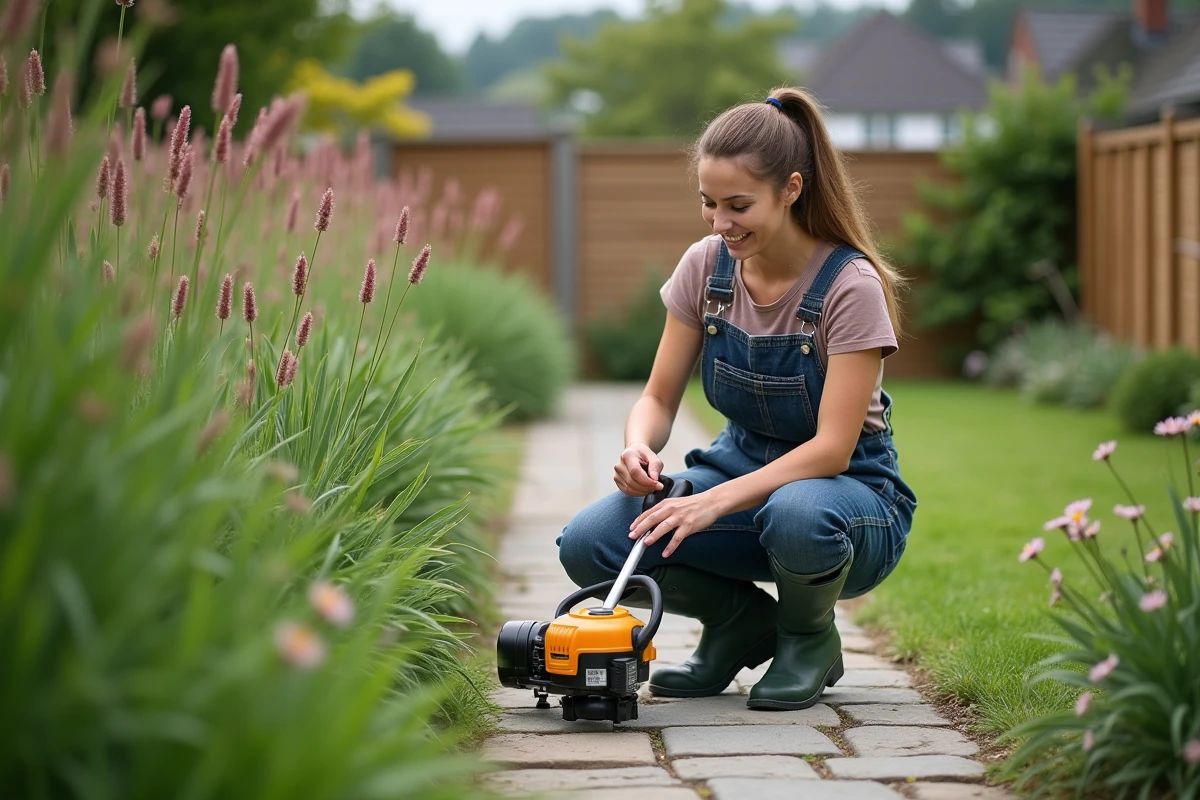
Practical tips for effectively using your string trimmer and achieving a professional finish
Mastering a string trimmer is not improvised. This tool, designed for finishing edges and accessing spaces overlooked by the mower, requires method and vigilance. Before starting, it is essential to equip yourself: glasses to protect against debris, sturdy gloves, thick shoes, and for gas versions, a noise-canceling headset. Every gesture counts for working safely.
To work efficiently, adopt these reflexes:
- Start by inspecting the work area. Remove stones, branches, or anything that could damage the cutting head or pose a danger.
- Handle the string trimmer with the head slightly tilted. Move forward with lateral, steady, and progressive motions: this helps avoid jolts for an even cut along the entire edge.
- To refine the finish around flower beds or tree trunks, reduce speed and maintain control over the tool. Precision makes all the difference here.
Regular maintenance is necessary to keep your gardening tool in good condition: clean after each use, check the nylon line or plastic blade, replace if worn. This discipline ensures an effective edger, ready to maintain a perfectly maintained garden throughout the year.
Between technical performance and precise gestures, the string trimmer transforms every edge into a clean line. The difference often lies in the details, where the gardener’s hand makes the difference. With each pass, it’s the pleasure of a garden that breathes care and mastery.