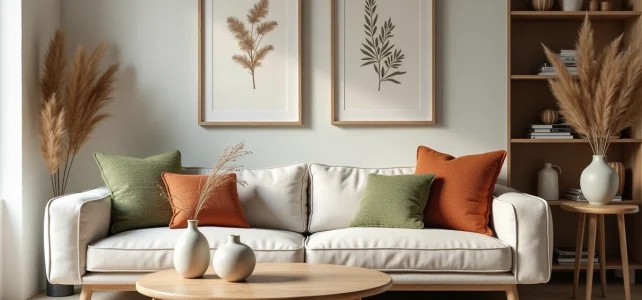
The choice of a coherent palette, the management of proportions, and the quality of materials are far more crucial to the success of interior decoration than the accumulation of trends. Here, we discuss the technical decisions that allow for a balance of aesthetics, functionality, and air quality within the same space.
Paints and Coatings: A Health Issue Before Being Aesthetic
The first instinct in interior decoration often involves choosing a color. The preliminary question should focus on the composition of the applied product. Prioritizing low VOC (volatile organic compounds) paints and coatings remains an essential precaution to preserve indoor air quality.
Further reading : Tips and Inspirations for a Daily Life Full of Sweetness and Creativity
The A+ labels on paint cans are not enough to guarantee satisfactory indoor air quality. Combining several A+ rated products can exceed recommended thresholds in a poorly ventilated room. We recommend checking the manufacturer’s complete technical data sheet, particularly the residual formaldehyde level after drying.
For those looking to explore wall finishes, lime-based plasters or bio-sourced paints offer a solid technical alternative. Their drying time is longer, but their long-term stability and permeability to water vapor make them suitable for humid rooms as well as bedrooms. You will find product references and techniques in the deco section of Univers du Bricolage, which also details the tools necessary for their application.
Read also : Ideas and Inspirations to Transform Your Interior with Style and Creativity
Proportions and Circulation in a Living Room or Bedroom
An oversized piece of furniture in a small living room creates physical and visual discomfort that neither color nor lighting can correct. Circulation takes precedence over aesthetics in any interior decoration project.
The basic rule we apply: maintain a clear passage of at least 60 cm between each furniture zone. Below this, the room generates a feeling of clutter that increases cognitive load and reduces attention capacity.

Sizing a Sofa Relative to the Room
A corner sofa in a living room of less than 20 m² is rarely a good choice. It blocks visual depth and imposes a fixed layout. A straight sofa, complemented by an accent chair, offers more flexibility to reorganize the space according to usage.
In a bedroom, the same logic applies to the bed. A queen-size frame in a narrow room eliminates any possibility of functional nightstands. It’s better to downsize and gain comfort in circulation.
Color Palette: Building Consistency Room by Room
An effective palette relies on a reproducible method, applicable regardless of the desired style.
- Define a dominant color (walls, floor) that occupies about two-thirds of the visible surface of the room. Neutral tones (off-white, warm gray, beige) work in most configurations.
- Select a secondary color for the main furniture and heavy textiles (curtains, rugs). It should contrast sufficiently with the dominant without competing with it.
- Reserve an accent color, brighter, for decorative objects, cushions, or frames. Limiting the accent to a single tone avoids visual dispersion.
This structure works regardless of the style sought, from minimalist design to a more elaborate decor. It also allows for evolving the decor without starting from scratch: changing the accents is enough to refresh the atmosphere of a living room or bedroom.
Common Mistake with Dark Colors
Painting a wall in a dark shade in a poorly lit room is not automatically a mistake. As long as the other walls remain light and artificial lighting is well distributed, a dark wall creates depth. The problem arises when the same shade is applied to multiple surfaces without light compensation.
Lighting in Interior Decoration: Layering Sources
A single ceiling light is the most common lighting flaw in French interiors. It flattens volumes, eliminates contrasts, and strains the eyes in the evening.
The professional approach involves layering three types of light sources in each room:
- A diffuse general lighting (dimmable ceiling light or pendant), which does not exceed a color temperature of 3,000 K for living areas.
- A targeted functional lighting (desk lamp, reading light, under-cabinet spots), directed towards the activity area.
- An ambient lighting (string lights, table lamp, indirect LED strip), which sculpts volumes and creates visual resting zones.
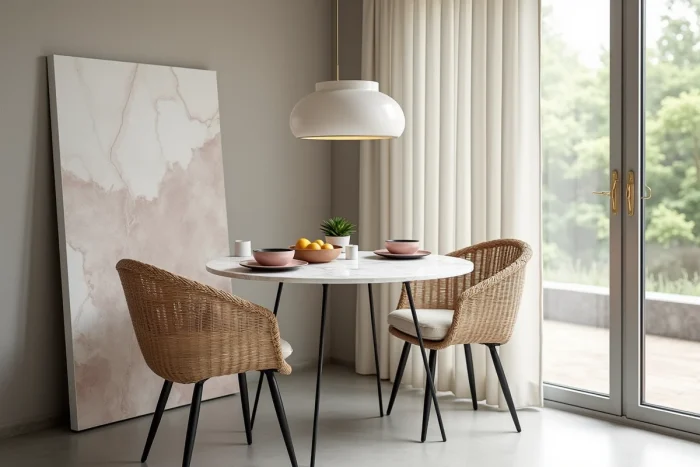
The combination of these three levels radically transforms the perception of a space, even without changing a single piece of furniture. It is often the most cost-effective lever in interior decoration.
Textiles and Natural Materials: The Detail That Anchors a Style
Furniture defines the structure of a room. It is the textiles that give it character. A wrinkled linen on a leather sofa, a jute rug under a metal table, a thick cotton curtain in front of a bay window: each material combination tells a different story.
Varying textures matters more than multiplying colors. A monochrome living room in beige becomes rich as soon as you mix in velvet, raw wood, ceramics, and woven fibers. Conversely, five colors in identical materials produce a flat effect.
Prioritizing natural materials (wood, stone, linen, wool) also contributes to indoor air quality. Cheap synthetic fibers release micro-particles and accumulate static electricity, two measurable discomfort factors over time.
Interior decoration gains coherence when each choice, from wall covering to accent cushion, adheres to a logic of proportion, material, and light. It is these concrete decisions that make the difference between a decorated space and a lived-in space.